
How small businesses are driving real change in disability inclusion
Lessons from the Disability Smart Impact Awards 2026
Organisations can find it difficult to turn DEI commitments into meaningful and impactful change. But if you want to see what real progress looks like, sometimes it pays to look at what small businesses are doing in this space, rather than concentrating only on the large multi-nationals.
Business Disability Forum’s Disability Smart Impact Awards 2026 highlight a clear and important lesson: smaller organisations have a vital role to play in delivering some of the most practical, impactful and scalable approaches to disability inclusion.
Action matters more than scale
Small businesses are leading by example by demonstrating that inclusion should be practical, that change can be incremental but still transformational and that impact comes from embedding inclusion right from the start, rather than including it as an add-on.
Across this year’s winners and finalists, a clear pattern has emerged. Smaller businesses aren’t waiting for perfect strategies, large budgets or global alignment Instead, they can sometimes be more agile than larger organisations simply because of their size. This means they can respond to opportunities, technological needs and gaps in the market quicker – playing to their strengths.
Redesigning services around real human need
You only have to look at the work being done by the small business winner of the Inclusive Customer Experience category, Accessible Housing Scotland (AHS), to realise the impact being felt by disabled people and their families during the stressful process of navigating the housing market.
The organisation works with clients across Scotland who have a wide range of needs. Rather than treating housing as a transactional process, AHS centres its approach on how people actually live. By understanding changing needs, they help disabled clients avoid unsuitable properties, reduce stress and make more sustainable choices.
The same principle can be seen from the Greenwich+Docklands International Festival (GDIF), the UK’s leading outdoor arts festival. They were a finalist recognised for embedding access into large-scale cultural experiences, as were Thrive Together Support, which was created to address a critical gap in post-school provision for adults with learning disabilities.
Embedding inclusion into everyday decisions
Small businesses are turning intention into action – quickly. One of the biggest barriers to disability inclusion is the gap between commitment and delivery, but many SMEs are able to introduce simple but effective processes by embedding inclusion into day-to-day decision-making.
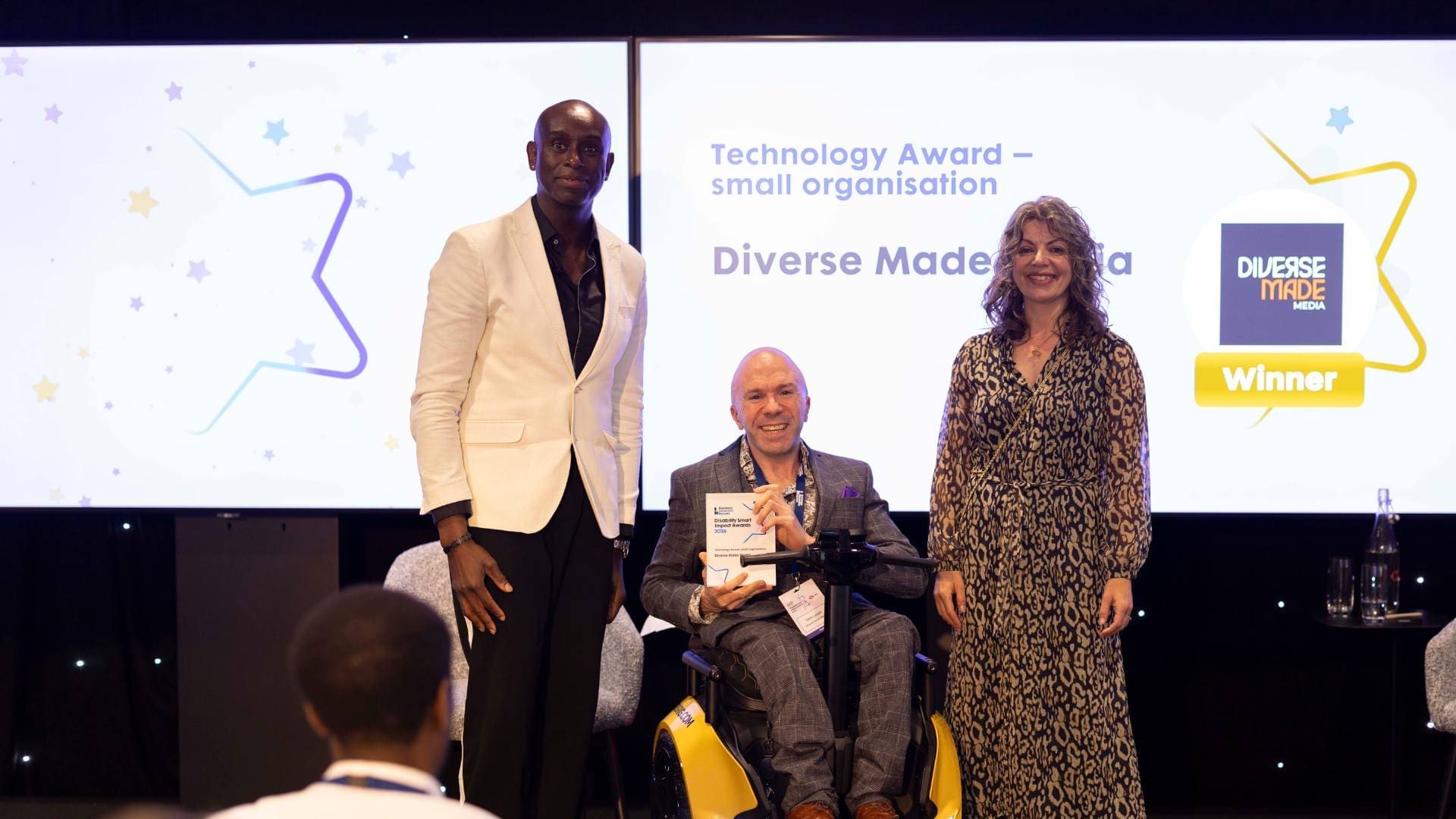
The winner of the Technology Award for small organisations was Diverse Made Media, the designer of CAERUS, the world’s first wheelchair camera system. This innovation has helped to remove a historic barrier in film and television by empowering disabled creatives to step behind the camera as independent operators for the first time.
The most immediate impact here is opportunity. It transforms camera operation — a role previously inaccessible to wheelchair users — into a realistic, paid and sustainable career path. This directly affects economic independence, professional progression, and long-term employability within the film and television industry.
SensePilot and Mobility Mojo were finalists in this category, and both show that accessibility isn’t just about compliance – it’s about dignity, independence and belonging.
What real change looks like
Where smaller businesses particularly stand out is in how they integrate inclusion into culture.
The aptly named Happy Smiles CIC, the winner of the Workplace Experience Award (small organisation) is the perfect example of how to embed inclusion into culture rather than isolating it – and having fun doing so. Disability inclusion should be owned by leaders across the business, and integrated into values, behaviours and everyday practices. With fewer than 10 employed staff and over 60 paid trainers, Happy Smiles uses their passion and agility to create a workplace rooted in trust, flexibility and lived experience, challenging traditional models that often harm disabled people’s physical and mental wellbeing.
This approach is echoed by finalists Evtec and Tilting the Lens. Evtec rebuilt its business model to create a workplace that is inclusive by design, rethinking everything from recruitment to development, while Tilting the Lens centres lived experience, co-creating solutions with disabled people and embedding their insight directly into leadership decisions.
These businesses are helping shift the narrative from inclusion as a responsibility to inclusion as a driver of performance and innovation, turning a personal barrier into a business opportunity. Our finalists and winners are showing what is possible. They are not just participants in the inclusion agenda but are playing a huge role in shaping its future.
Learn more about this year’s small business finalists from the full list of this year’s finalists and winners. Alternatively, our Knowledge Hub offers practical advice for smaller businesses, including How to make your website more accessible and How to welcome disabled visitors.