Last updated: 15 April 2026
If clients or customers visit your business premises, there is a good chance that some of them will have a disability since 1 in 4 people in the UK is disabled.
Accessible premises are vital for making sure your disabled employees, customers, and anyone else who uses your premises, are included.
Here’s a few things to keep in mind when welcoming disabled visitors to your premises.
Planning and booking appointments
Check your online information. Most people will check you out online before making an appointment or dropping in. If there is level access or a lift, say so on your website or Facebook page and show pictures. Show and describe the spaces in which you see clients or visitors. Mentioning parking and public transport options and any notable features such as a steep hill or cobbles is also a good idea.
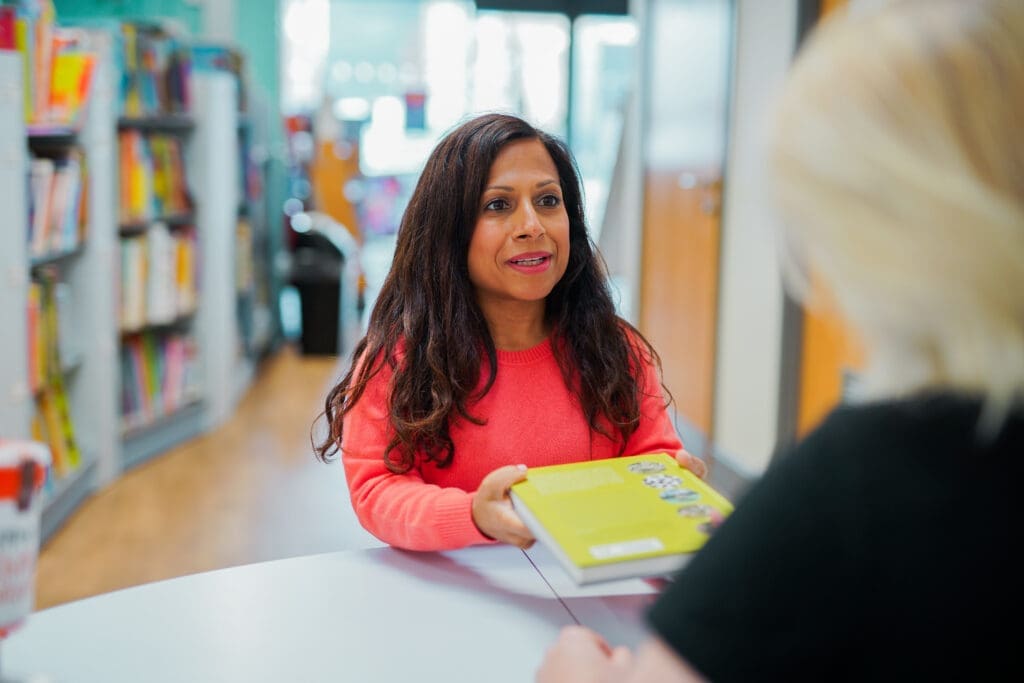
Give visitors the opportunity to tell you about any particular requirements they have for the meeting – whether they book online, over the telephone or another way. Ask all clients this as you may not necessarily know if someone has a disability. This gives clients the opportunity to let you know what they need.
Explain in advance what will happen during the meeting including who else will be there and why. Tell clients how long the appointment will last, anything they need to do in advance – for example, bring paperwork or a friend/family member or what to wear/not wear. Remember to say whether there will be access to toilets or changing areas. If you have an accessible toilet, remember to mention this on your website or when an appointment is booked.
If you are going to be discussing complex information – for example, medical, financial or legal – your client might need to bring or contact someone to help them understand the meeting. This could be a sign language interpreter or lip speaker for someone who is deaf or a support worker or family member or friend for someone who has a learning disability or mental health condition.
Face-to-face interpreters are often in demand and will require advanced booking. Online video interpreting can be booked at short notice, and provide remote real-time interpretation via a PC, mobile device or smart phone.
Ask before the appointment if the customer would like information emailed in advance. Some people will not be able to read printed information provided at the meeting – for example, because they use electronic screen readers or have other access needs. Offer to follow up with accessible information if it is not available on the day
Entrances
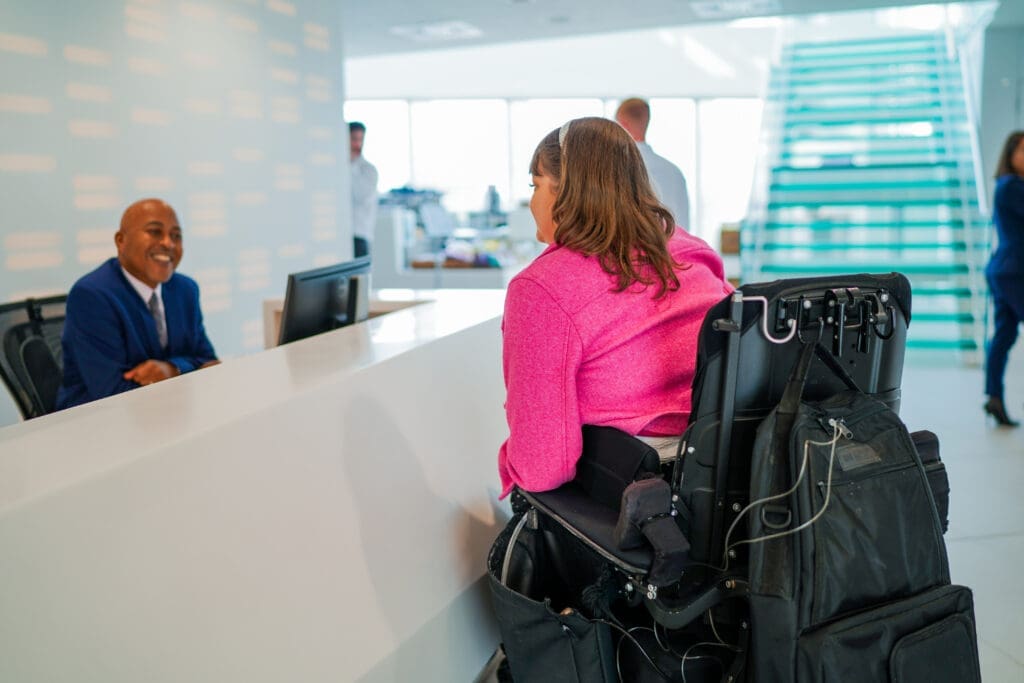
Make sure people can get to the entrance without needing to use stairs – for example by installing ramps. Doors can also be a barrier – revolving doors or heavy, non-automatic doors can be difficult for some disabled people to use. Install automatic, non-revolving doors instead of (or as well as) any inaccessible entrances you currently have.
Changing the door type may be costly for some small businesses – but you can still make small changes to improve the accessibility of entrances. The most effective is always to have a member of staff positioned by the entrance to offer assistance if required. If that is not possible, consider installing an intercom system so disabled people who can’t use the entrance can ask for help.
Navigation
Once inside, disabled people can still face barriers when trying to move around the premises. Confusing or unclear signage can be a significant barrier to some disabled people. Make sure that signs are clear, accurate and readable. Good contrast is important so that people with sight loss can see the signs. Avoid for example, dark grey on light grey. Dark blue on yellow is far easier to see.
It’s important for disabled people who can’t use stairs to be able to move around your premises. That means making sure that there are lifts between all floors, and that these lifts aren’t too far away from some parts of the premises – such as toilets.
Lighting and décor
Your premises need to be well lit so that people can get around without difficulty.
However, excessively bright lights can also be a barrier for some disabled people – for example people with autism who can be more sensitive to external stimulation.
Lighting can be a tricky area. What is accessible for one person (for example, well-lit spaces suit many people with sight loss), can be distressing to others (for example, some people with autism who experience sensitivity to sensory stimulation). No one likes flickering light and it can be a trigger for migraines or seizures – so a flickering light should be removed and replaced as quickly as possible.
Furniture and utilities
If you provide seating, try to ensure there are options at different heights, and with and without arm rests, for example.
If you provide toilets, then you should ensure that either the main toilets are accessible for wheelchair users or that you have an easily accessible (and unlocked) accessible toilet.
Features such as kitchens and shower rooms should be made accessible, rather than providing alternatives. For example, you could lower counter tops so that people in wheelchairs can reach them and install taps with automatic sensors so that people who face barriers relating to dexterity can still use them.
When meeting and welcoming people
Be on time. If you are running late or have to move an appointment, give the client as much notice as possible. Clients may have had to plan their trip or organise assistance such as a paid-for carer who is only available for a limited amount of time to get to the appointment, so rearranging at short notice may be difficult for them.
Don’t make assumptions about the client’s needs or abilities. Give them plenty of opportunity to tell you how they would like a service delivered or the item which they think is best for them. They are the expert and are probably used to coming up with different ways to achieve the same result.
The client may need longer to read through forms and information. Be ready to explain the information.
Provide different payment options if you can and say in advance what they are – for example, if you only accept cash. Some disabled people can find it difficult to obtain cash, others may find it hard to remember a PIN, and others may find writing or signing a signature difficult, or the signature may be inconsistent.
If you require this content in a different format, contact [email protected].
© This resource and the information contained therein are subject to copyright and remain the property of the Business Disability Forum. They are for reference only and must not be copied or distributed without prior permission.