
At a glance
• Artificial intelligence (AI) has huge potential to increase productivity and accessibility for disabled employees – if used correctly.
• Organisations should create strong AI governance frameworks to ensure high standards of disability inclusion.
• AI tools should be used to augment human judgement, not replace it. Ensure work and decisions involving AI are reviewed by a human with the authority to change them.
• Disabled workers need to be involved in AI development and use, from defining the need, to procurement, testing, and post-delivery reviews.
Common accessibility barriers in artificial intelligence
Artificial intelligence is increasingly being used by people in all areas of life, especially at work, due to the huge benefits it offers in improving productivity. The potential benefits to both organisations and individuals are significant.
However, as with any new and emerging technology, organisations must ensure they implement and manage the use of AI consciously. If not carefully managed, AI could have unintended consequences, such as excluding, hampering, or discriminating against disabled people.
Some of the risks of AI that need to be considered and mitigated are:
Artificial intelligence bias against disabled people
Artificial intelligence models are trained on data generated by humans, which can reflect biases in society. This leads to potential discrimination against disabled people.
For example, a 2024 study asked ChatGPT-4 to rank CVs against identical CVs that were enhanced with disability-related leadership awards, scholarships and memberships. ChatGPT exhibited prejudice against disability-related CVs. This shows that, without safeguards, use of AI tools can disadvantage disabled people.
Hallucinations and inaccuracies
Common artificial intelligence tools that people use are Large Language Models (LLMs). These programmes are ‘trained’ on huge amounts of human-generated content, and then use probabilities to predict the most likely sequence of words to generate responses to prompts. IBM has a more detailed explanation.
Because LLMs are trained on data generated by humans, they can contain inaccurate information which they then may replicate. LLMs also sometimes make things up when they can’t find the answer to a question, which is known as ‘hallucinating.’ Both of these tendencies can disproportionately harm disabled users, especially if artificial intelligence is being used as an accessibility tool. For example, a disabled person may be given incorrect accessibility information about a venue, resulting in them spending money on a ticket only to be unable to access the premises.
Inaccessible artificial intelligence tools
While artificial intelligence has huge potential as an accessibility aid, some AI tools do not have fully integrated accessibility features. Not all AI programmes are accessible to screen readers, and they also may produce outputs that are not accessible.
Disabled workers must not be required to use tools that are not accessible to them. Otherwise, their work and morale may suffer, leading to lower productivity for the organisation and disadvantage for the individual.
Speed of deployment
Many organisations are deploying artificial intelligence into their workstreams at significant pace and scale. This potentially creates a barrier for disabled people whose ways of working are disrupted if the change is not managed in a considered way. Disabled workers should be given opportunities to become familiar with new ways of working with AI, and to feedback on potential accessibility issues, before full-scale deployment.
How organisations can avoid barriers in AI use
While there are potential barriers in artificial intelligence use, organisations can manage them to realise the benefits of artificial intelligence for all employees. Below, we outline the four foundational actions that organisations should take when implementing AI use.
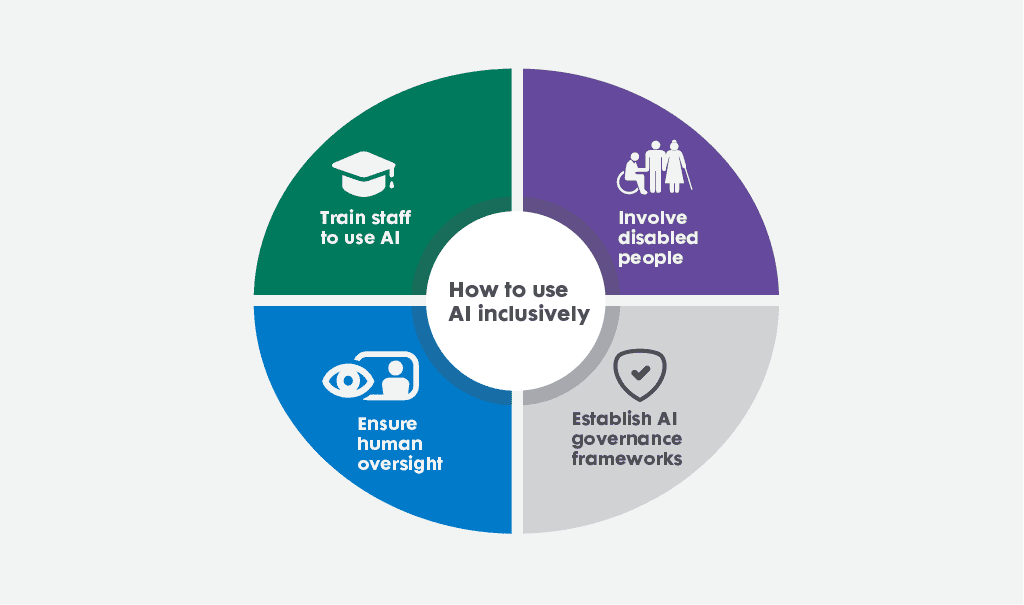
Tip 1 – Involve disabled people in the AI lifecycle
Organisations should consult disabled people about AI use, from conception and testing to post-deployment reviews and upgrades. This includes identifying opportunities to implement AI into workflows, defining what is needed from AI tools, testing AI tools before they are deployed, and providing feedback after AI tools are implemented.
Disabled experts should also have a role in creating the AI governance framework and an ongoing role in governance. Crucially, they should have the power to reject AI tools that do not meet the organisation’s disability inclusion standards.
Organisations should consult with:
- Disability network groups.
- Experts in digital inclusion.
- Senior inclusion and accessibility champions.
Tip 2 – Establish AI governance frameworks
A mature AI governance framework should:
- Explain what the organisation wants to achieve with its use of AI. Many organisations feel pressure to adopt AI quickly. Defining what outcomes AI should achieve will mean that adoption will be targeted and avoid unnecessary disruption to disabled employees’ ways of working. Organisations should have specific and measurable objectives that align with the needs of the business, its employees and its customers.
- Place disability inclusion at its heart. Accessibility and disability inclusion should be core considerations that are non-negotiable in AI use. It should define what disability inclusion in AI use looks like and establish processes for checking that this is being delivered from the design stage through to deployment and beyond.
- Work with existing accessibility systems. The framework should outline how AI tools can ensure compatibility with existing systems and accessibility tools that disabled employees use. It should reference the organisation’s inclusive technology standard or framework. This is vital to ensure that the organisation’s systems, apps and platforms do not become inaccessible due to AI use. Employees must be able to continue to use assistive technologies with any AI tool that is introduced.
- Have responsible owners for responsible AI. There should be a named senior executive who has objectives to ensure AI is used responsibly and with a particular focus on disability. The framework should also explain how they should work with other teams (such as Technology teams) to deliver disability inclusive AI use.
- Include disabled experts. The governance framework should empower disabled people with relevant expertise to oversee and review how AI is used, and to reject AI tools and uses that do not meet the organisation’s disability inclusion standards.
- Align with legal and regulatory requirements. This includes anti-discrimination laws, like the UK’s Equality Act. A mature AI governance framework will explain how the organisation’s use of AI aligns with its legal duties to avoid discrimination and protect disabled employees’ sensitive information. One way to prevent sensitive data ‘leaking’ is to reduce use of external AI tools (such as free-to-use chatbots) and provide in-house AI tools that have been ‘ringfenced’ – meaning data that employees put in is not used to train the LLM in future.
Tip 3 – Ensure human oversight of AI use
To use artificial intelligence accessibly and avoid discrimination, organisations should ensure that it augments human work rather than replaces it. Left unsupervised, AI tools may automate and amplify existing biases against disabled people.
Artificial intelligence should never fully replace human decision making. It needs human oversight – or Human-in-the-Loop (HITL) – to avoid discrimination against disabled people, work efficiently, and align with the organisation’s values.
What HITL looks like will depend on the nature of the work that is being augmented with artificial intelligence. Generally speaking, it means implementing policies and procedures that check for unfavourable outcomes and create opportunities for human intervention to correct errors, adjust its use, or suspend its use if needed.
IBM has a more detailed explanation of what HITL means.
Tip 4 – Train staff to use artificial intelligence
Whether or not your organisation has integrated AI into its work, your employees are likely already using it. A 2025 report [PDF] from MIT found that while 40 per cent of companies had purchased an LLM subscription, 90 per cent of employees were using an LLM regularly.
Only 40% of companies have purchased an LLM subscription – but 90% of employees use an LLM regularly.
This ‘shadow AI economy’ exposes your organisation to significant risks, because artificial intelligence is being used in ways that are not subject to governance frameworks. This means employees may input sensitive information, work based on flawed LLM outputs, and replicate the biases against disability through their use of AI.
This means staff must receive training on how to use artificial intelligence responsibly – covering both corporate AI tools and publicly available AI tools.
Training should seek to achieve two aims:
- All employees – including disabled employees – should receive training on how to use all AI tools they are required to use for their work. This includes accessibility features and adjustments to remove or reduce barriers they may experience.
- All staff should be trained on how these AI tools work. This is more than simply training on what buttons to press. Staff should know the advantages and limitations of these technologies so that they can critically engage with them, identify errors or hallucinations, and use their judgement to make them work. Without this training, employees may misuse AI tools, leading to lost productivity, discrimination, data leaks, or legal and regulatory breaches.

Join the Technology Taskforce
Interested in AI and digital inclusion? BDF Members and Partners can join our Technology Taskforce, a group of senior IT accessibility professionals from leading UK and global organisations, working together to improve the use of inclusive design and accessible technology.