

Global Conference shows how disability inclusion can drive change
Business Disability Forum (BDF)’s fifth Global Conference – ‘Delivering disability-inclusive change in global organisations’ – certainly lived up to its name as hundreds of delegates from nearly 40 countries gathered to share ideas, learn from one another and explore how organisations can continue making progress on disability inclusion in an increasingly challenging environment.
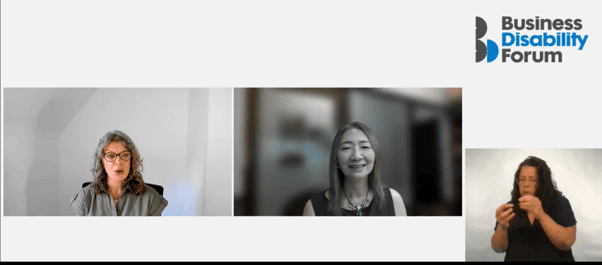
Opening the conference, Diane Lightfoot, BDF’s CEO, highlighted the clear benefits that disability inclusion brings for disabled people, society and organisations alike. She also reflected on the significance of seeing so many countries represented at the event.
Shared commitment
“It demonstrates a shared commitment to making workplaces and services more accessible and inclusive,” she said.
That commitment is more important than ever. Recent feedback from BDF Members and Partners shows many organisations are facing significant challenges. Around 30% of Members and 38% of Partners said that the negative global narrative around inclusion had affected their work over the past year. At the same time, 13% of Members and 24% of Partners reported that diversity, equity and inclusion (DEI) had been deprioritised, while others pointed to reduced resources as a barrier to progress.
“Against this backdrop, a key question emerges: how do we continue driving meaningful change when uncertainty and disruption seem to be constant features of working life?” she said.
Diane and our second keynote speaker, Lyn Lee, DEI strategist and author of ‘Tiny Rice Grains’, a Straits Times non-fiction bestseller, agreed that the answer begins with people. In a rapidly changing world, organisations must equip employees with the skills and support they need to adapt and thrive.
As Lyn said: “It can feel overwhelming, particularly in the current climate, to see how we can each make a difference. But it is vital to focus and not try to do everything at once. Every small action and working together can lead to effective change.”
Small steps equate to meaningful impact
That theme of small steps creating meaningful impact ran throughout the day.
Artificial intelligence is a prime example of how employers and employees need to adapt to a changing work environment. While there are understandable concerns about the impact of AI on jobs, it is also creating demand for new capabilities. Human-centred skills, such as collaboration, communication and bringing teams together around a shared purpose, are becoming increasingly valuable.
Another recurring theme was the idea of progress over perfection. Delegates heard repeatedly that organisations do not need to have all the answers before they take action. What matters is maintaining momentum and learning along the way.
Strong leadership also emerged as a critical ingredient for success. Lyn spoke passionately about the influence leaders can have in driving inclusion.
“We assume that leaders have all the answers but we are all learning together. (I have seen) many times senior leaders who are champions end up being inspired, they learn a lot about themselves and what they can do more visibly and how they can support the inclusion journey with their voice and influence. That’s the one trick that organisations should not miss.”
The importance of global champions
That sentiment was underpinned by global research undertaken by BDF a few years ago, which found that 91 per cent of respondents believed that a global champion was vital. Leaders who have the power and authority in organisations should take up that mantle and be that person who can help others be seen, heard, respected and valued.
“That’s what leadership is all about. We know the smallest of actions can help. Leadership is an action for all of us, no matter where we sit in the organisation or the world,” emphasised Lyn.
There was also plenty of reason for optimism.
Colleagues from Bangladesh, Thailand and Poland shared how disability networks are growing and helping to build more inclusive workplaces in their countries. Encouragingly, membership numbers continue to rise, and disability inclusion is becoming increasingly embedded within many larger organisations.
We also heard inspiring stories of progress from organisations including Coca-Cola Europacific Partners and L’Oréal. Delegates shared practical examples of how accessibility matrixes, inclusion awards and other initiatives are helping to turn good intentions into meaningful action.
Perhaps the biggest takeaway from the day was that while disability inclusion may be a global ambition, real change happens locally. Global strategies are important, but they only succeed when people on the ground take ownership and bring them to life.
By working together across countries, sectors and cultures, organisations can continue creating lasting change and building workplaces where disabled people can succeed, regardless of the challenges ahead.
Go to our Knowledge Hub for information on the Global Disability Smart Assessment. The Global Taskforce, free for BDF Partners (and an additional fee for Members), brings together global organisations committed to improving disability inclusion, wherever they are in the world.