

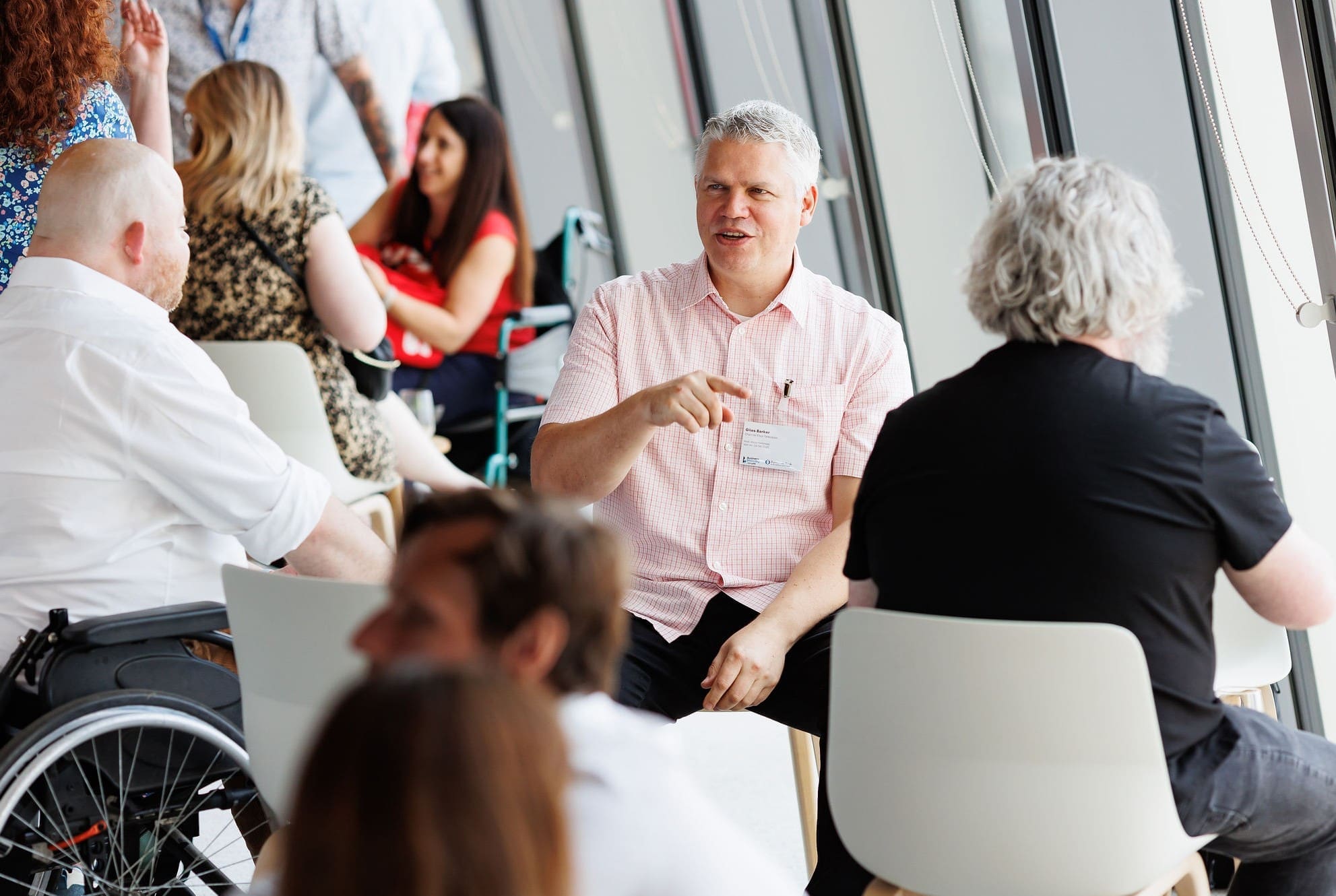
Inclusive event planning – A continuous learning journey

By Georgina Whitehead, Events Manager, Business Disability Forum
Inclusivity is at the centre of everything we do here at Business Disability Forum. But no matter what your business does, inclusivity at events is important. By removing barriers to participation, you can reach a wider audience and with that, invite diverse perspectives and expertise. You can be confident that you are creating a space where no one is excluded, and everyone is equal.
I’ve been the Events Manager at Business Disability Forum since 2022. While I brought over 20 years events management experience to the role, I quickly realised that – while I thought I had always provided accessible events – there was so much more I could do to design events that are fully inclusive to all.
I learned a lot in my first few months, and that learning hasn’t stopped. And that’s OK. There is always something new to learn and no event goes by where an observation from one of the team, or direct feedback from an attendee, hasn’t improved the accessibility of our next event. It’s important to recognise that, as event organisers, we might not always get it right – but we should always ask how we are doing, listen to feedback and find solutions.
Budgets are often the biggest challenge. Accessibility must be factored in at the very first stages when developing an event and setting your budget. Of all the accessibility features you could implement, decide what is essential for your event and cost it. Then consider anything else that might be requested and cost that too. It’s always better to be prepared to supply what might be needed at the planning stages, to avoid last minute retrofitting that might end up being more costly if not part of your contingency planning.
If you do the thinking early and the projected costs are higher than your budget allows, you have time to consider revising the event format. For example, an in person or hybrid event could be moved online, or shortened to offset accessibility costs against room hire and catering costs. If accessibility is embedded into your core planning, then you would no more press ahead with your event if you couldn’t afford the accessibility measures, than you would if you couldn’t afford the audio-visual equipment.
That’s the challenging bit.
The good news is there is so much you can do that is low cost and easy
Be thorough in your communication
Include clear accessibility information at the point of booking so your attendees know exactly what is being provided and ask at every contact point if they need any further adjustments. For example, Will sign language interpretation be provided? Will materials be sent in advance? Is parking available?
Follow up on all adjustment requests to make sure arrangements are spot on and let the attendee know how they can ask for further support if they need it. When your event opens, brief your host to restate information about accessibility, and your staff team can also do this in online chat spaces.
Design an inclusive programme
Avoid any very long sessions and make sure your programme has regular breaks that are long enough for the number of people attending. Be clear about the format of each session and let your attendees know if you’re planning anything unusual. Online events will have a mechanism to ask questions, but it’s often beneficial to offer one at in person events too because raising a hand to ask a question might be a barrier to participating.
Walk the route
Physically or virtually, step through your attendees’ journey from your registration form, to arriving at the venue or accessing your events platform, and their experience throughout the event. You may want to do this several times, for example first assessing from the perspective of someone with sight loss or sensitivity to bright lights, then from the perspective of a wheelchair user or someone with restricted mobility, then again with hearing loss in mind.
Sometimes you will be able to make simple adjustments – for example:
- Providing clearer signage.
- Repositioning lighting.
- Reducing glare from presentations.
- Allocating a staff member to key points (such as lifts if there are no audio announcements, or to doors through to accessible toilets if the doors aren’t automatic).
Where the environment can’t be adapted, provide additional information to attendees. For example, you could share guidance on your event platform for screen reader users or highlight in advance if there is feature lighting in a particular area that cannot be adjusted.
Brief your speakers
Ensure that your speakers present with accessibility in mind. This means presentation slides that are clear, screen reader compatible, and with content that will all be presented verbally as well as visually.
All video content should be audio described, and speakers should talk slowly and clearly. Your host should be well briefed to ensure they enable speakers and attendees to participate fully.
Lean on your support team
Make sure your full staff team know about everything that has been put in place to ensure your event is accessible. For example, do they know if there is a quiet space if they are asked and can they locate it?
Consider allocating team members to greet attendees who have requested adjustments, even if they haven’t specifically asked for assistance. This means they will be clear on the provisions in place and will have a contact point if there is anything they need.
Ask for feedback
Ask your attendees for feedback specifically on accessibility of the venue or platform, the overall event design and communication, via your event feedback survey. Where possible, seek feedback on the day by talking with attendees who have requested adjustments. Ask them if there is anything more you could do to make their experience even better. It can also be insightful to review online event chat to learn what could be made clearer to attendees at future events.
A lot of these practical measures will not only ensure your event is accessible to attendees with disabilities or long-term conditions, but your event is also likely to be a better experience and more inclusive for all. It’s win, win.
For more information, read more our new resource on ‘How to plan accessible and inclusive events’ (open to Members and Partners only, with some pages open to all).