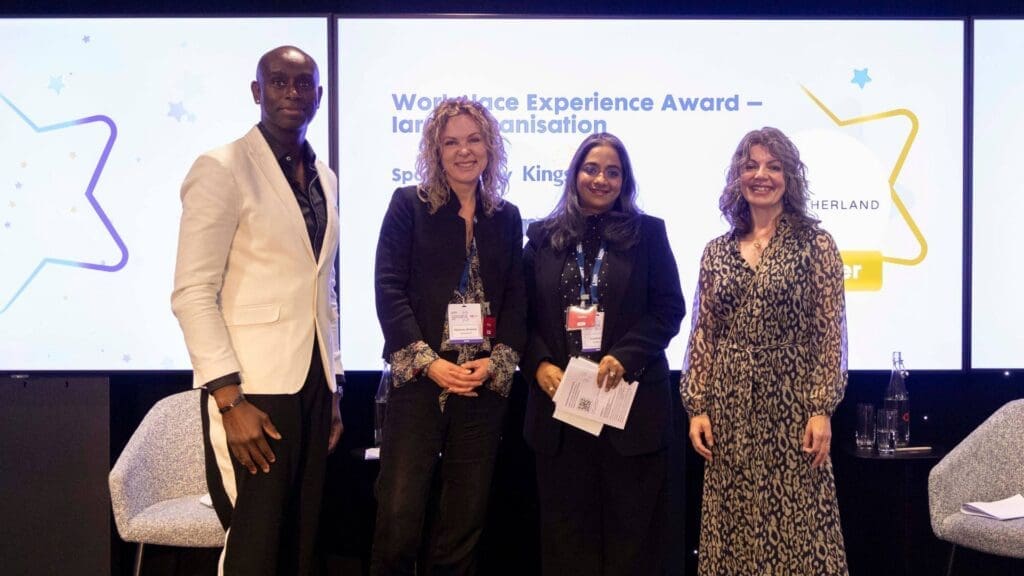
Workplace Experience Award (large organisation): Sutherland
Recognised for embedding accessibility, wellbeing and progression into a connected workplace system, delivering measurable improvements in productivity, engagement and career outcomes.

WINNER: Sutherland
Sponsored by:
About Sutherland
Sutherland is a global leader in business and digital transformation. Over the past 38 years, it has partnered with leading organisations to drive revenue growth, improve operational efficiency, and enable innovative business models.
Issue
Disabled employee engagement at Sutherland was limited by fragmented and reactive support, where accessibility depended on individual disclosure and case-by-case adjustments. Inconsistent tools, limited role matching, and a lack of embedded wellbeing and assistive infrastructure increased cognitive load, reduced confidence, and slowed progression. As a result, employees with disabilities experienced lower participation, higher attrition, and fewer clear pathways for career advancement.
What they did
Sutherland built an integrated accessibility ecosystem designed to anticipate needs, remove barriers, and support the full employee lifecycle for people with disabilities.
At its core is predictive, accessible-by-default infrastructure. Employees receive assistive technology before day one, and core systems, including collaboration tools, dashboards, and learning platforms, are designed and validated for accessibility from the outset. This reduces reliance on disclosure and supports both permanent and temporary accessibility needs.
The organisation introduced evidence-led role mapping and accessibility audits to identify where different disability profiles can succeed, improving job matching and reducing friction for all employees.
Accessibility is reinforced through employee-led technology validation, ensuring systems work in practice, not just in principle.
Health, safety, and wellbeing are embedded into the system through inclusive emergency protocols, clinician-designed wellbeing tools, adaptive fitness options, and a structured learning academy focused on resilience and psychological safety. A network of 130+ clinician-trained Wellness Champions provides distributed peer support across regions.
These components operate as a connected system: early enablement supports role matching, which informs technology configuration and accessible work design. Wellbeing sustains performance, while inclusive leadership and sponsorship pathways convert access into progression.
Impact
Sutherland’s inclusion strategy delivers measurable improvements across performance, wellbeing, and progression.
People with disabilities deliver 11% higher productivity and 50% lower attrition than organisational averages.
Psychological safety has strengthened, with voluntary disability disclosure increasing by 51%, reflecting greater trust in available support.
Wellbeing outcomes are strong, with an 83% Global Wellness Score, 87/100 wellbeing NPS, improved work-life balance (79%), and reduced absenteeism (9.27%). Engagement with wellbeing resources is high, including over 12,000 fitness app downloads and 7,500 active users.
Career progression is improving through structured mentoring (PAL programme), with nearly 100 participants achieving a 43% promotion rate and 87% retention of high performers.
These outcomes are consistent across geographies and industries, demonstrating scalability across global operations in technology, telecom, healthcare, retail, and travel.
Together, these outcomes demonstrate that embedding accessibility, wellbeing, and progression into core operations improves both daily experience and long-term career outcomes for disabled people.
If you require this content in a different format, contact [email protected].
Highlighted content

Disability inclusion for Desk-Free Workers
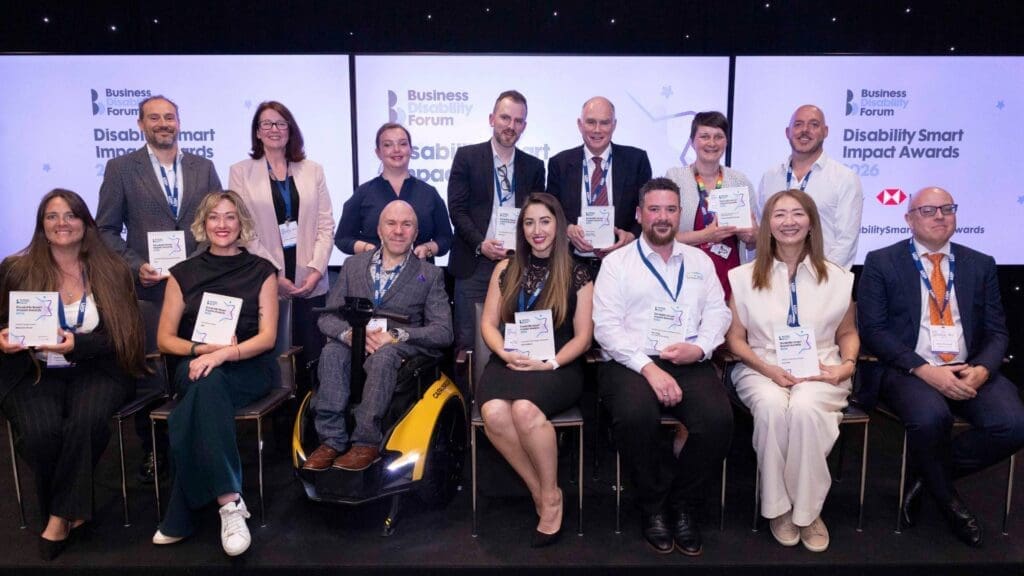
Disability Smart Impact Awards 2026 winners